


Asiga has developed various building trays for various liquids and applications. These are material trays for the liquids in the printers. Asiga printers such as the Asiga Max, Max2, Pico, Freeform Pro, Max X, Max mini, Pro4K, and the Asiga Ultra use various material trays, such as the Universal tray, UltraGloss Tray, Endurance Tray, Lift Tray, CrownKit, and the standard trays used in older printers.
Trays are often offered in 1L, 2L, 5L, and 10L capacity variants, depending on the tray. These volumes reflect the built-in counters/RFID and stock size; they do not always have a completely different shape and therefore require a larger material tray capacity. Asiga recommends using one tray per material (no mixed materials) to prevent contamination.
Schouten Dental supplies these material trays for every printer from stock in the Netherlands, Belgium, and throughout Europe. For both older printers and all current Asiga printers.
Below is an overview with the various details of these Asiga Building Trays.
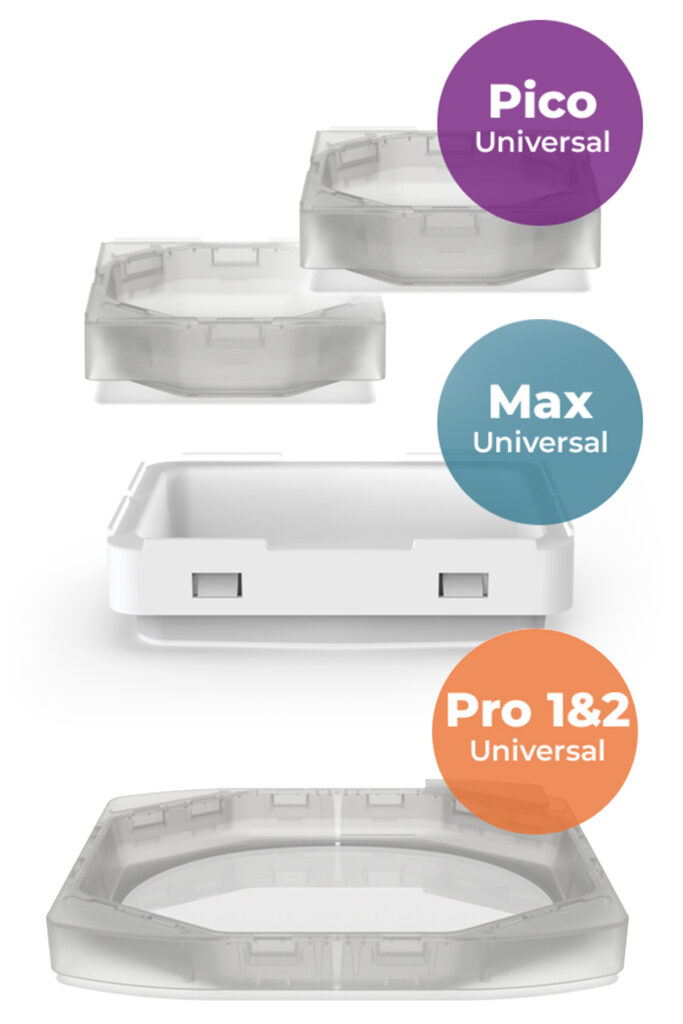
Universal Tray - 1L, 2L, 5L, & 10L
What is an Asiga Universal Tray? The standard Asiga tray, used on previous models and available on current printer models, features a flex film in a rigid frame tray designed for most Asiga resins (this tray provides a matte/fine surface finish). The Universal Tray is available in 1L, 2L, 5L, and even up to 10L sizes, depending on the model, and compatible with the MAX family, PRO Freeform, and PICO series, depending on the model.
Ideal for standard prints such as diagnostic models, setups, jig/aligner prototypes, and general dental prints.
Advantages
Wide range of materials (general applications).
Robust and inexpensive to purchase.
Predictable, matte surface finish (minimal post-processing).
Disadvantages
Medium gloss (not suitable if you want glossy/pre-polished parts).
With some heavy or sticky materials, the film may wear out more quickly; follow-up is required.
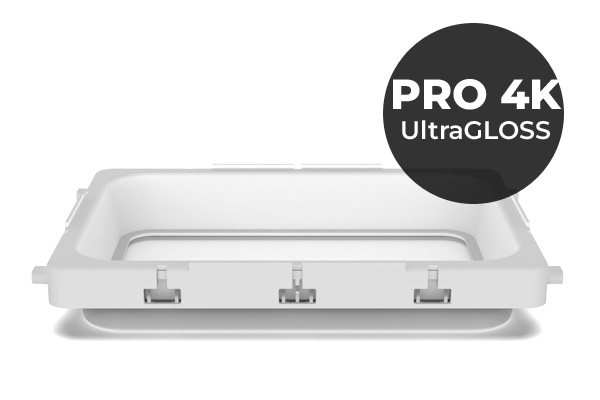
UltraGLOSS™ - Build Tray
What is an UltraGloss tray? The UltraGloss version is designed to give transparent materials a smooth, glossy (pre-polished) finish directly from the printer, significantly reducing post-processing for applications where gloss is important. This is often used in splint printing. Polishing is immediately reduced by approximately 90%. UltraGloss is available for the Asiga MAX, PRO 4K, and Ultra printers.
Benefits
Instantly polished parts, meaning significantly less polishing after printing.
Very useful for visible restorations, presentation parts, or where a smooth finish is desired.
Disadvantages
Slightly less universal and designed for transparent materials (testing for each material is important).
Higher price than standard resin trays.
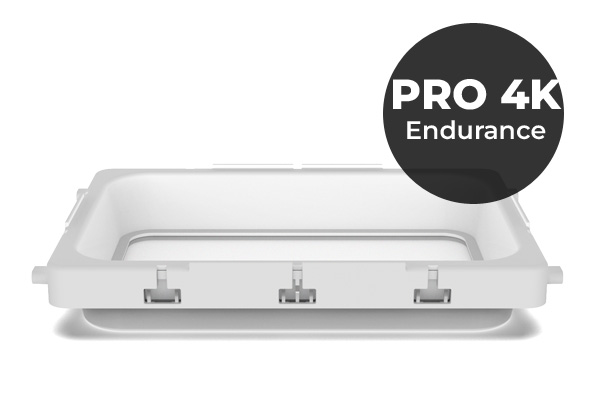
Endurance™ Build Tray
Wat het de Endurance Build Tray? Vloeistof bak Endurance is geconstrueerd om hoge levensduur / langere gebruiksduur te bieden voor veeleisende en hoge-omvang productieomgevingen zoals het printen van groot volume in modellen, lepels, try-ins en prothese basissen.
Hoge-volume productie, labs met veel throughput, toepassingen waarbij tray-vervanging frequent wordt.
Benefits
Longer lifespan for multiple prints, lower replacement consumption.
More reliable for production environments.
Disadvantages
More expensive per piece.
Not every print finish requires this investment.
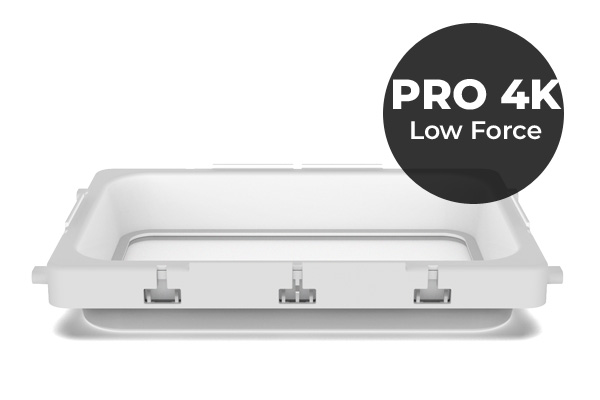
Low-Force Build Tray
The Low Force trays are specially designed with a specific film layer that reduces peeling forces during delamination (lower bond forces), reducing the risk of deformation or breakage during peeling for delicate or flexible components. Available for MAX/MAX X (1L) and the standard tray for the Asiga Pro 4K. Asiga sometimes recommends the standard or Endurance tray for hard materials.
Flexible biocompatible resins, thin-walled restorations, fine orthodontic hooks, or small, delicate geometries.
Benefits
Less peel stress → resulting in better prints of thin, flexible, or fragile structures.
Reduces print failures due to overly tight bonding.
Disadvantages
Not always ideal for very hard materials (Asiga recommends a standard tray for hard materials).
May require slightly different settings (supports/exposure).
Important technical and practical notes (must-knows)
Material trays with volume (1L/2L/5L/10L): This number often refers to the tray’s registered/set capacity (RFID/electronic counter/stock perception), not necessarily to a distinct physical tray form factor.
One tray per material: Asiga recommends using a tray for a single material (to avoid cross-contamination and unexpected chemical interactions). This prevents deteriorating print quality issues.
Maintenance & lifespan: Wear and tear is primarily caused by hard/abrasive additives or improper first-layer contact. Regular inspection and timely replacement prevents print damage. Asiga support has maintenance guides specific to each MAX/PRO model. When not using specific resin trays or materials, it is recommended to store the fluid back in the bottle.
Practical selection guide — which tray should I choose for which application?
General production / wide variety of materials: Universal/Standard tray — affordable, reliable.
If you want a glossy/visible finish immediately: UltraGLOSS™ — saves polishing time.
For fragile, thin, or flexible prints: Low-Force / LIFT™ — less peel stress.
High volumes and durability important: Ultra Endurance™ or a durable version.
If you print with PRO 4K / PICO: use trays specific to that series (resolution and size-oriented).